Choose your anchor
Explore a paper on its own, or pick a point in an existing graph. Its particular concepts define the next question.
 A Sensus InVista Project
Explore a document, follow a question, or build a connected body of knowledge. Understand more, with the evidence always within reach.
Gnothis pairs AI that helps you understand with a separate knowledge collection you can inspect, revisit and grow. A personal step towards the InVista vision.
Research often ends with an answer, a report, or a stack of open tabs. Gnothis is being built for what comes next: returning to an idea, questioning it, connecting it, and making it part of a lasting body of knowledge.
Start with a question in your own words, a document or a link. Stay within that source for focused learning, or commission wider discovery around it. A single document can become a collection of connected sections, each traceable to its parent source.
Preserve the original material and the exact passages behind an explanation.
Explore concepts, claims and relationships in a map you can inspect.
Decide which knowledge belongs in an answer, and when to go further.
The research task creates a reusable collection. Reports, explanations and learning experiences are then grounded in that preserved material.
Scope the question, identify useful URLs and papers, and propose the categories that will organise them.
Extract available content into consistent Markdown, recording its origin and capture date alongside the passages.
Organise sources, sections and concepts as connected Gnodes, ready for exploration and semantic search.
Ask questions, compare findings or create a report using the evidence and context you choose.
Start with a clear foundation. Add context deliberately. Bring the layers together when they help you understand.
Its methods, claims and preserved passages.
A focused branch adds definitions and background sources.
Ask what the paper says, using only the original material. Missing context remains a visible gap.
Showing a branch on the map and including it in an answer are separate choices.
A source is a beginning. GnodeSpan lets you follow the concepts inside it, then follow the concepts you discover next.
Start from a new document or URL, or select an existing Gnode—a source, section, concept or claim in your map. The same discovery, extraction and graph-building process runs again, scoped to that anchor. Each span adds a distinct layer of supporting context, with its sources preserved.
You choose when to span, what to investigate and which branches to include in an answer. Each new Gnode can become another starting point: a paper leads to a method, the method to its assumptions, and those assumptions to a new question. There is no fixed conceptual endpoint; each expansion remains a deliberate, scoped task.
Explore the layersExplore a paper on its own, or pick a point in an existing graph. Its particular concepts define the next question.
Identify the methods, people, places or ideas you want explained. Commission a bounded research task around that selection.
Discover sources, extract the available material and connect the evidence. Accepted results form a secondary branch, with their relationship to the anchor preserved.
Span again from a new Gnode, or bring selected branches into your learning context. Added depth remains distinguishable from the original source.
An illustrative path through successive, user-initiated spans.
Read its claims and the passages supporting them.
Add sources that explain how the method works.
Follow the assumptions and competing approaches.
InVista imagines a wider, continuously connected knowledge layer. GnodeSpan explores that principle through deliberate tasks: the learner chooses each expansion, and the graph grows with their questions.
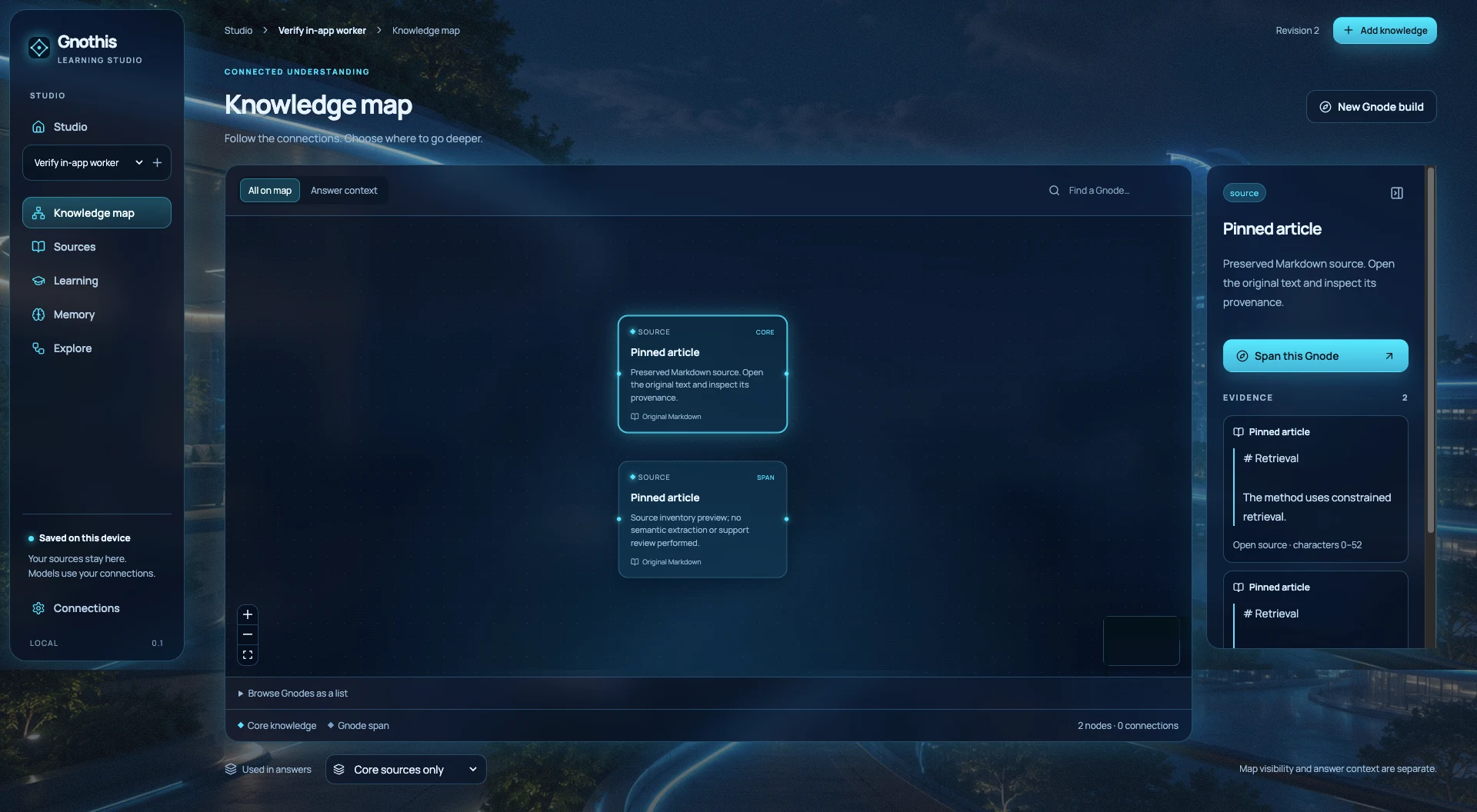
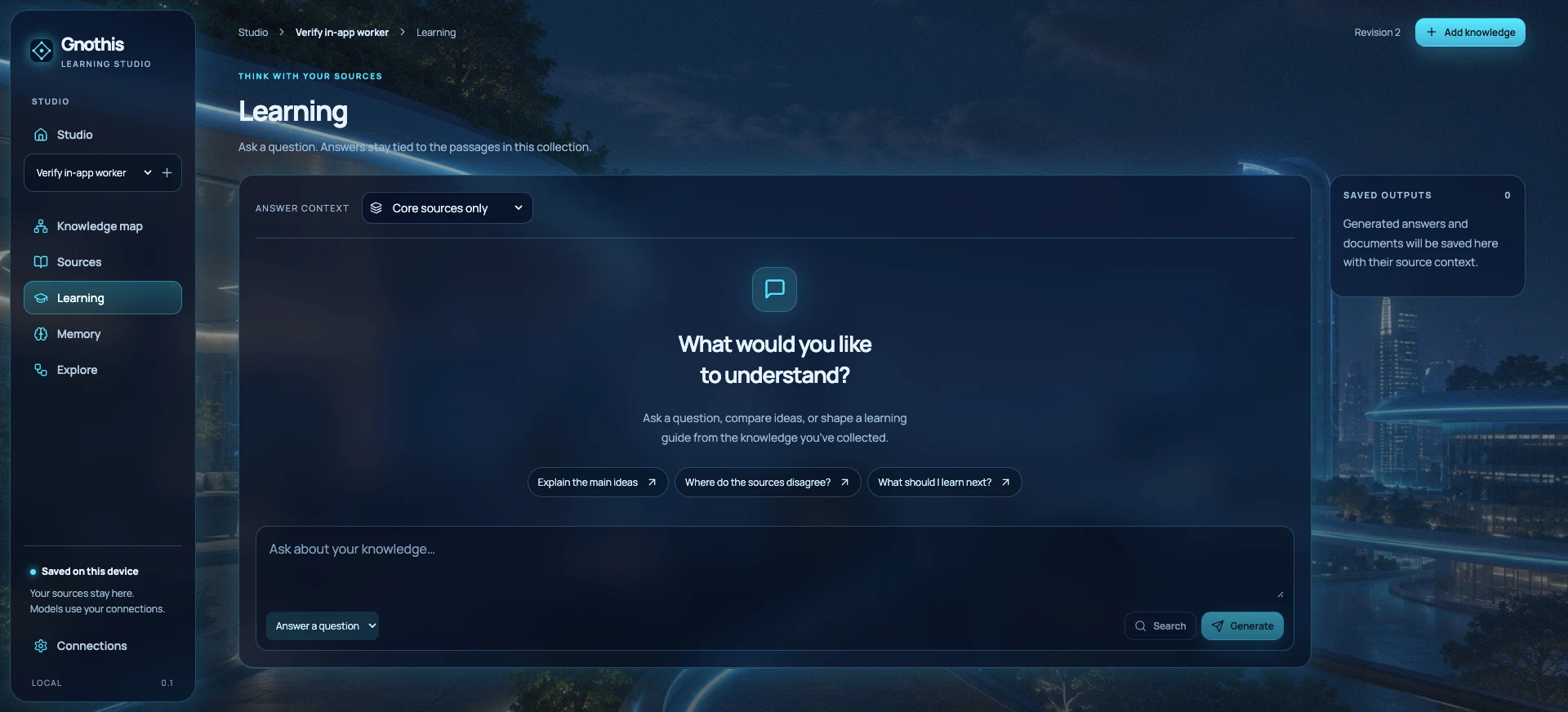
The first interface brings the map, source evidence and learning conversation into one local workspace.
Ask for an explanation, compare ideas or shape a learning output from selected material. Saved outputs retain their source context.
These screenshots show an early interface and test collection. They are a development snapshot, not a finished product demonstration.
Follow the development of an idea, a body of research, a company or a historical subject through the material in your collection.
Timeline Review is conceived as a narrated, chaptered web experience: source imagery, key developments and an explanation of what changed, with the evidence available at every point.
The aim is an immediately playable experience on your device, with video rendering needed only when you choose to export.
Organise the material by publication or event date, keeping the distinction clear and leaving uncertain dates visible.
Move between chapters, hear a narrated walkthrough and return to the sources behind each point.
Pause on an idea, inspect the evidence or use it as the starting point for a GnodeSpan.
A subject-agnostic learning format, currently a development priority rather than an available feature.
The model’s role is to synthesise and understand. The evidence belongs in a separate, adaptable knowledge layer that can be inspected, updated and reused. This is the architectural ambition behind Gnothis: smaller, agentic models with access to the material a task needs, and a collection that remains useful as models change.
Smaller, agentic models could make more learning possible on personal devices. The current core runs as a local web service, with separately configurable embedding and chat connections.
The aim is to reduce unnecessary data exposure and compute demands while respecting creators and access rights. Processing location depends on the services chosen; lower environmental impact remains an ambition to evaluate.
Source URLs, capture dates and exact passages anchor the collection. The goal is expandable evidence excerpts and automatically formatted Harvard references in generated outputs. Attribution makes a claim inspectable; it does not, on its own, establish truth.
Knowledge becomes more useful when people can see where it came from, how it connects, and what remains uncertain.
InVista is the wider vision of a living knowledge layer: information that can be updated, traced to its origins and explored from an overview down to the exact passage. Gnothis develops a personal route into that vision, through preserved sources, deliberate expansion and learning grounded in evidence.
A learner chooses a question, preserves the evidence and follows new context through GnodeSpan.
Connected, updateable knowledge whose origins and changes remain available for inspection and reuse.
The social purpose: fairer access to knowledge, stronger public accountability and greater agency for people and communities.
Gnothis is in pre-alpha development. The local core has been built; the interface and research workflow are still evolving. There is no public product release yet.
Markdown source storage and versioning, evidence passages, graph exploration, persistent memory, scoped retrieval, saved outputs and configurable model endpoints.
Agent task contracts and a handoff bridge are in place. Research execution, conversion tools, skills and real model connections require configuration and continued validation.
Timeline Review is a priority: narrated, chaptered learning grounded in dated sources. Guided pathways, stronger portability and wider InVista knowledge exchange remain development goals.
Gnothis is an early contribution to Sensus InVista’s long-term vision for InVista: making knowledge easier to access, verify and use, with human agency at its centre.
Experimental work through Sensus Labs helps test the foundations. OpusAI connects that work to practical applications, while Liberty Rise keeps equity, rights and public benefit central to its purpose.
The direction is a future in which people can follow how understanding was formed, question its foundations and build on it with confidence.
Receive updates as Gnothis develops. Or bring a question, an idea or a perspective to the conversation.
Collaboration, expertise and aligned partnerships can help shape this foundation for ethical AI, accessible learning and verifiable knowledge.
Explore the wider mission